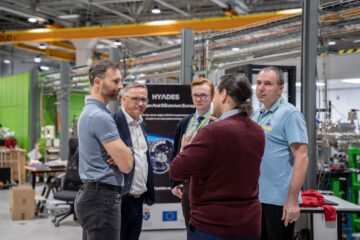
On October 21 a lecture was held as part of “Bliżej Nauki” (Closer to Science), a series of popular science lectures organized at the Faculty of Physics, Astronomy, and Applied Computer Science of the Jagiellonian University in Krakow.
During the lecture, Michał Drahus, head of the HYADES mission, presented the scientific goals of the project, the technological challenges facing his team, and how far-ultraviolet research could open a new chapter in the discovery of our cosmic neighborhood, including interstellar objects passing through the Solar System.
Abstract:
Where did the water on Earth come from? Could its history have begun far beyond our planet – among comets and asteroids orbiting cold cosmic paths? Scientists from the Faculty of Physics, Astronomy, and Applied Computer Science at the Jagiellonian University are seeking answers to these questions as part of the HYADES mission – the first space mission of the Jagiellonian University. HYADES involves launching a small but extremely precise telescope observing in the far ultraviolet into low Earth orbit. Its task will be to detect hydrogen and deuterium – elements that are key to understanding the origin of water in the Solar System. With this instrument, researchers hope to answer questions such as whether comets could have delivered water to the young Earth billions of years ago.