HYADES is a low-Earth-orbit (LEO) survey-type mission designed for five years of nominal operations, with an extended mission lifetime possible. The spacecraft will use a Sun-synchronous orbit and carry a dedicated ultraviolet payload for studying water and its isotopic composition in comets, active asteroids and interstellar objects.
Faint light from these targets will be collected by a Ritchey–Chrétien telescope with a 50 cm diameter. The telescope will feed two complementary scientific channels: a high-resolution spectrograph and an imager. The proposed measurements are based on precise, ultra-sensitive spectroscopy of gaseous comae, supported by imaging observations in the same spectral range.
Measurement principle
When cometary ice sublimates, it releases water molecules into the surrounding coma—the extended cloud of gas and dust around the nucleus. Solar ultraviolet radiation then breaks these molecules apart through photodissociation. One of the resulting fragments is the hydroxyl radical, OH, which contains one oxygen atom and one hydrogen atom.
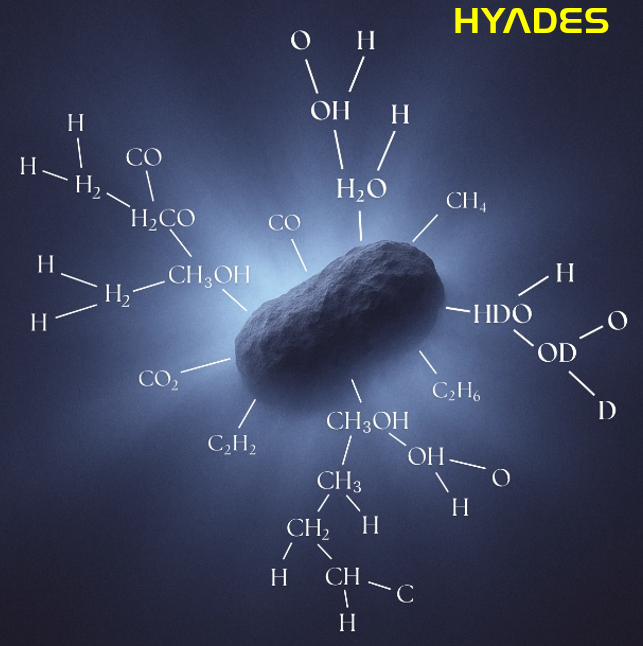
Hydroxyl can be observed in comets through its intrinsically bright ultraviolet emission band near 309 nm. Water is overwhelmingly its main source in ordinary cometary comae, making OH an excellent tracer of water-ice sublimation. The observed emission is produced by fluorescence: molecules absorb sunlight and subsequently re-emit radiation at characteristic wavelengths.
Water containing deuterium, the heavier isotope of hydrogen, can produce deuterated hydroxyl, OD. HYADES will target its diagnostic fluorescence line at 307.42 nm, together with nearby OH emission. Comparing the two signals, with appropriate photochemical and fluorescence modelling, allows scientists to determine the deuterium-to-hydrogen ratio, D/H, in the original water.
For an ocean-like D/H ratio, OD emission is approximately three orders of magnitude weaker than OH emission, and its diagnostic features lie in a crowded near-ultraviolet spectral region. HYADES therefore combines high spectral resolution, efficient light collection and very-low-noise detection.
The investigation of water and its isotopic composition through hydroxyl offers several important advantages: intrinsically bright emission, overlapping wavelength ranges enabling simultaneous observation, well-separated diagnostic lines, exactly the same field of view for both species, and negligible optical depth under the intended observing conditions. Measuring OH and OD together also reduces uncertainties associated with comparing observations obtained at different times or across different regions of a variable coma.
Observing modes
HYADES will combine two observing capabilities.
High-resolution spectroscopy will separate the incoming light into its constituent wavelengths. The resulting spectrum reveals the emission lines of individual species, allowing the weak OD signature to be distinguished from nearby features. A long entrance slit will also preserve information about how the emission changes with position across the coma.
Imaging will record the spatial distribution of gas through selected ultraviolet bands. These images will show how the coma extends around the nucleus, how its structure evolves and where the spectroscopic measurements are being obtained.
The instrument will support imaging alone or simultaneous spectroscopy and imaging. Together, the two channels will connect the chemical information in a spectrum with the wider spatial context of the observed object.
Photon-counting ultraviolet detectors will register individual photon events. Their low-noise operation is well suited to observations in which the useful signal accumulates slowly. Combined with efficient optics and sufficiently long observations, this approach will enable measurements of targets whose gas emission is difficult to study with general-purpose facilities.